TERAQUAT 20SL – Paraquat Dichloride 20% Fast-Acting Contact Herbicide
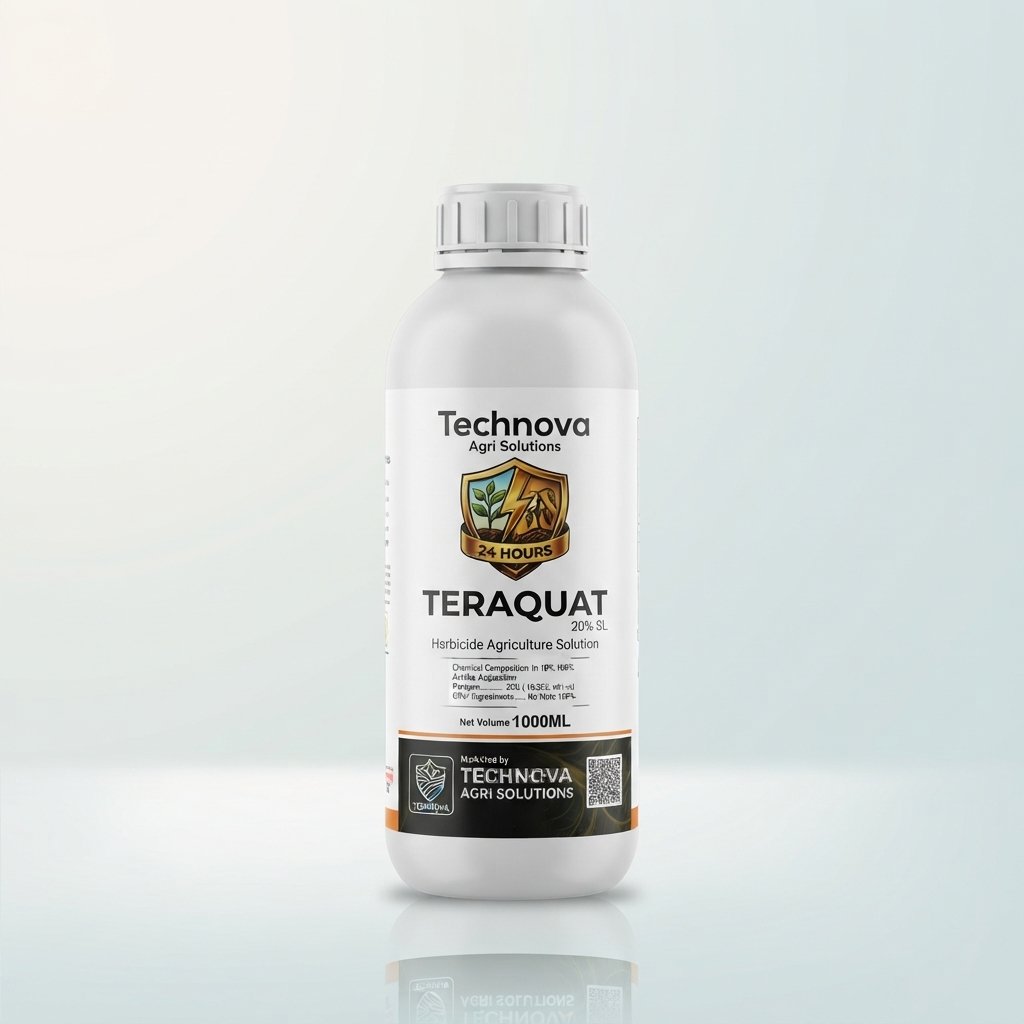
TERAQUAT 20SL by Technova Agri Solutions is a fast-acting, broad-spectrum, non-selective agricultural herbicide formulated with Paraquat Dichloride 20% SL (200 g/L).
Belonging to the Bipyridylium chemical family, TERAQUAT 20SL provides rapid contact activity against susceptible emerged weeds. It works by disrupting the photosynthetic electron transport system, leading to oxidative damage, destruction of plant cell membranes and progressive drying of treated green foliage.
Visible weed injury can develop rapidly under favorable environmental conditions, often within 24–48 hours. The actual level and speed of control depend on weed species, application coverage, environmental conditions and susceptibility.
Important: Paraquat is an extremely hazardous pesticide. TERAQUAT 20SL must be handled only by appropriately trained and legally authorized agricultural applicators, according to the registered product label and applicable regulations.
Key Features & Benefits
- Fast-Acting Contact Herbicide: Produces rapid visible damage on susceptible green plant tissues.
- Broad-Spectrum Weed Management: Acts against various susceptible emerged broadleaf weeds and grasses.
- Paraquat Dichloride 20%: Contains 200 g/L of the stated active ingredient.
- Non-Selective Action: Damages susceptible green vegetation, including desirable plants exposed to spray.
- Post-Emergence Weed Control: Acts primarily on existing green foliage rather than preventing new weed germination.
- Photosystem I Activity: Disrupts photosynthetic electron transfer and causes oxidative injury.
- Rapid Foliar Desiccation: Causes leaf discoloration, wilting, browning and tissue drying.
- Limited Soil Residual Herbicidal Activity: Paraquat binds strongly to soil particles and does not provide reliable residual control of newly germinating weeds.
- Soluble Liquid Formulation: Supplied as an SL concentrate for approved agricultural applications.
Technical Specifications
| Technical Parameter | Specification |
|---|---|
| Product Name | TERAQUAT 20SL |
| Brand / Manufacturer | Technova Agri Solutions |
| Product Category | Pesticides |
| Subcategory | Weedicides / Herbicides |
| Active Ingredient | Paraquat Dichloride |
| Stated Concentration | 200 g/L (20% w/v) |
| Formulation Type | Soluble Liquid (SL) |
| Chemical Family | Bipyridylium |
| HRAC / WSSA Group | Group 22 |
| Mode of Action | Photosystem I Electron Diverter |
| Herbicide Selectivity | Non-Selective |
| Herbicidal Activity | Contact Action |
| Application Stage | Post-Emergence |
| Visible Weed Response | Often within 24–48 hours under favorable conditions |
| Soil Residual Weed Control | No reliable residual weed prevention |
| Pack Size | 1 Liter Bottle |
How TERAQUAT 20SL Works
TERAQUAT 20SL contains Paraquat Dichloride, a non-selective contact herbicide classified under HRAC Group 22.
1. Photosystem I Electron Diversion
Paraquat interferes with normal electron transport associated with Photosystem I (PSI) in photosynthetically active plant tissues.
Instead of allowing electrons to move through their normal pathways, Paraquat diverts electrons toward molecular oxygen, initiating the formation of reactive oxygen species.
2. Formation of Reactive Oxygen Species
This process generates highly reactive oxygen compounds, including superoxide radicals and other damaging oxidative species.
These compounds interfere with normal cellular functions and contribute to the breakdown of essential plant structures.
3. Destruction of Plant Cell Membranes
Oxidative damage leads to rapid deterioration of cell membranes, chloroplasts and other cellular components.
Affected plant tissues lose their ability to regulate water and maintain normal biological activity.
4. Rapid Foliar Wilting & Desiccation
Susceptible treated foliage may develop:
- Rapid leaf discoloration.
- Wilting and loss of tissue firmness.
- Brown or black scorch symptoms.
- Progressive drying of treated green tissues.
- Necrosis and foliage collapse.
5. Contact Activity Rather Than Systemic Root Control
Unlike systemic herbicides, Paraquat has limited movement from treated foliage into distant plant tissues and underground plant structures.
It primarily affects green surfaces receiving adequate exposure. Established perennial weeds may recover through surviving roots, rhizomes or tubers.
Target Weed Spectrum
Paraquat-based herbicides have contact activity against a broad range of susceptible emerged weeds. The following species are examples of weeds relevant to agricultural weed management. Specific control claims for TERAQUAT 20SL must be confirmed from its approved registration label.
1. Annual Broadleaf Weeds
| Common / Local Name | Scientific Name |
|---|---|
| Itsit / Horse Purslane | Trianthema portulacastrum |
| Bathu / Lamb’s Quarters | Chenopodium album |
| Jangli Chulai / Wild Amaranth | Amaranthus viridis |
| Qulfa / Common Purslane | Portulaca oleracea |
2. Annual Grasses
| Common / Local Name | Scientific Name |
|---|---|
| Swank / Jungle Rice | Echinochloa colona |
| Dumbi Sitti / Little Seed Canary Grass | Phalaris minor |
| Crabgrass | Digitaria spp. |
3. Perennial Weeds – Top-Growth Suppression
| Common / Local Name | Scientific Name |
|---|---|
| Deela / Purple Nutsedge | Cyperus rotundus |
| Khabbal / Bermuda Grass | Cynodon dactylon |
| Lehli / Field Bindweed | Convolvulus arvensis |
Important: Paraquat may destroy exposed foliage without killing perennial underground structures. Weed regrowth is possible, and complete or permanent eradication should not be assumed.
Agricultural Applications & Weed Management
Paraquat-based herbicides are used in certain agricultural weed management programs, subject to local product registration and strict application restrictions.
1. Pre-Planting Weed Management
Where authorized, contact herbicides may be used for managing emerged weeds before establishing a new crop.
Because Paraquat is non-selective, contact with desirable green crop tissues can cause severe plant damage.
2. Directed Weed Management in Established Orchards
Some registered Paraquat products permit carefully controlled, directed applications in specific orchard systems.
TERAQUAT 20SL must not be used in orchards unless the exact crop and application method are authorized on its registered label.
Any permitted operation must meet all requirements for applicator protection, drift prevention and protection of desirable vegetation.
3. Agricultural Non-Crop Areas
Use in field borders, agricultural margins or other non-crop locations is permitted only when specifically listed on the registered product label.
Do not apply directly to irrigation channels, flowing water, ponds, canals or other water bodies unless an explicit legal authorization covers that use.
Dosage & Application Requirements
Official Product Label Required: The correct quantity of TERAQUAT 20SL, spray-water volume, application equipment, permitted weed stage and treatment method must be taken from the current registered product label.
| Application Situation | Requirements |
|---|---|
| Young Annual Weeds | Use only the approved label rate and permitted application method. |
| Dense or Mature Weeds | Follow product-label limits; do not increase concentrations beyond registered instructions. |
| Perennial Weed Foliage | Confirm label authorization and account for possible regrowth from underground structures. |
| Field Borders / Non-Crop Areas | Application only where the registered label specifically permits treatment. |
Sprayer Calibration: Mixing instructions, nozzle requirements, approved dilution rates and necessary personal protective equipment must come from the official product label and applicable safety training.
Because Paraquat is extremely toxic, unverified tank-mixing quantities or knapsack dosage recommendations must not be used.
Expected Weed Control Symptoms
Visible symptoms from Paraquat exposure may develop rapidly in susceptible plants, especially under conditions favorable for photosynthetic activity.
| Approximate Period | Possible Weed Response |
|---|---|
| First 24 Hours | Early leaf discoloration, wilting and visible scorch symptoms may develop. |
| 24–48 Hours | Increased browning, tissue damage and foliar desiccation may become apparent. |
| Following Days | Damaged above-ground foliage may continue drying and deteriorating. |
| Later Growth | Perennial weeds may regrow from surviving roots, rhizomes or underground storage structures. |
Note: Visible response times are approximate and depend on weed species, exposure, growth conditions and weather. Rapid foliage damage does not establish permanent root control.
Contact Herbicide vs. Systemic Herbicide
| Characteristic | Paraquat Contact Herbicide | Glyphosate Systemic Herbicide |
|---|---|---|
| Primary Activity | Contact action on exposed foliage | Systemic activity following foliar absorption |
| Visible Symptoms | Usually rapid | Generally gradual |
| Movement Within Plants | Limited | Moves toward actively growing tissues |
| Underground Weed Structures | Usually limited control | May affect underground tissues of susceptible weeds |
| Residual Soil Weed Control | No reliable residual control | No reliable residual control |
Herbicide Resistance Management
Paraquat belongs to HRAC / WSSA Group 22, the Photosystem I electron diverter group.
Repeated dependence on herbicides with the same mechanism of action can contribute to herbicide-resistant weed populations.
- Monitor fields for surviving or resistant weeds.
- Avoid repeated reliance on one herbicide mode of action.
- Use appropriate non-chemical weed management practices.
- Prevent surviving weeds from producing seeds.
- Follow local agricultural extension recommendations.
- Use alternative herbicides only when registered and appropriate for the particular location and target weeds.
Critical Safety & Handling Precautions
WARNING – EXTREMELY TOXIC HERBICIDE: Paraquat can cause fatal poisoning. Even a small amount swallowed may cause death. There is no proven antidote. Exposure through damaged skin, eyes or inhalation of spray mist can also cause serious injury.
- Authorized Professional Use: Handling and application must comply with all local registration, training and applicator authorization requirements.
- Personal Protective Equipment: Use all label-required chemical-resistant protective clothing, gloves, eye and face protection, footwear and properly specified respiratory protection.
- Never Use Household Containers: Do not transfer Paraquat into drinking bottles, cups, food containers or unmarked packaging.
- Prevent Inhalation: Avoid exposure to droplets, aerosols and spray mist.
- Avoid Skin & Eye Exposure: Prevent direct contact and promptly follow emergency decontamination instructions if exposure occurs.
- Equipment Safety: Never handle or apply using leaking, damaged or unsuitable pesticide equipment.
- Protect Other People: Keep unprotected individuals, children and animals away from handling and treatment areas.
- Protect Water Sources: Prevent drift, spills and contamination of ponds, streams, canals and drinking water.
- Observe Re-Entry Restrictions: Follow every label-specified restriction after treatment.
- Safe Storage: Keep tightly sealed in the original labeled container, secured against unauthorized access.
- Proper Disposal: Follow the registered product label and local hazardous pesticide waste regulations.
Emergency Poisoning Information
If Paraquat is swallowed or exposure is suspected, seek emergency medical care immediately. Do not wait for symptoms to appear. Do not induce vomiting unless specifically instructed by qualified medical professionals.
Inform healthcare personnel that the product contains Paraquat Dichloride and provide the product container or label if this can be done safely.
There is no proven antidote for Paraquat poisoning, making prevention of exposure critically important.
Product Information at a Glance
- Product Name: TERAQUAT 20SL
- Brand: Technova Agri Solutions
- Active Ingredient: Paraquat Dichloride
- Stated Concentration: 20% (200 g/L)
- Formulation: Soluble Liquid (SL)
- Chemical Family: Bipyridylium
- HRAC Group: 22
- Herbicide Selectivity: Non-Selective
- Mode of Action: Contact / Photosystem I Electron Diversion
- Application Stage: Post-Emergence
- Pack Size: 1 Liter Bottle
- Category: Pesticides – Herbicides / Weedicides
Disclaimer: All product composition details, weed-control claims, application rates, rainfastness intervals, approved agricultural uses and safety requirements must be verified against the current TERAQUAT 20SL product label and applicable regulations in Pakistan. Paraquat is an extremely toxic herbicide and must be handled only by legally authorized, appropriately trained users. Results vary according to weed species, environmental conditions and application practices. A single treatment does not guarantee permanent weed eradication.