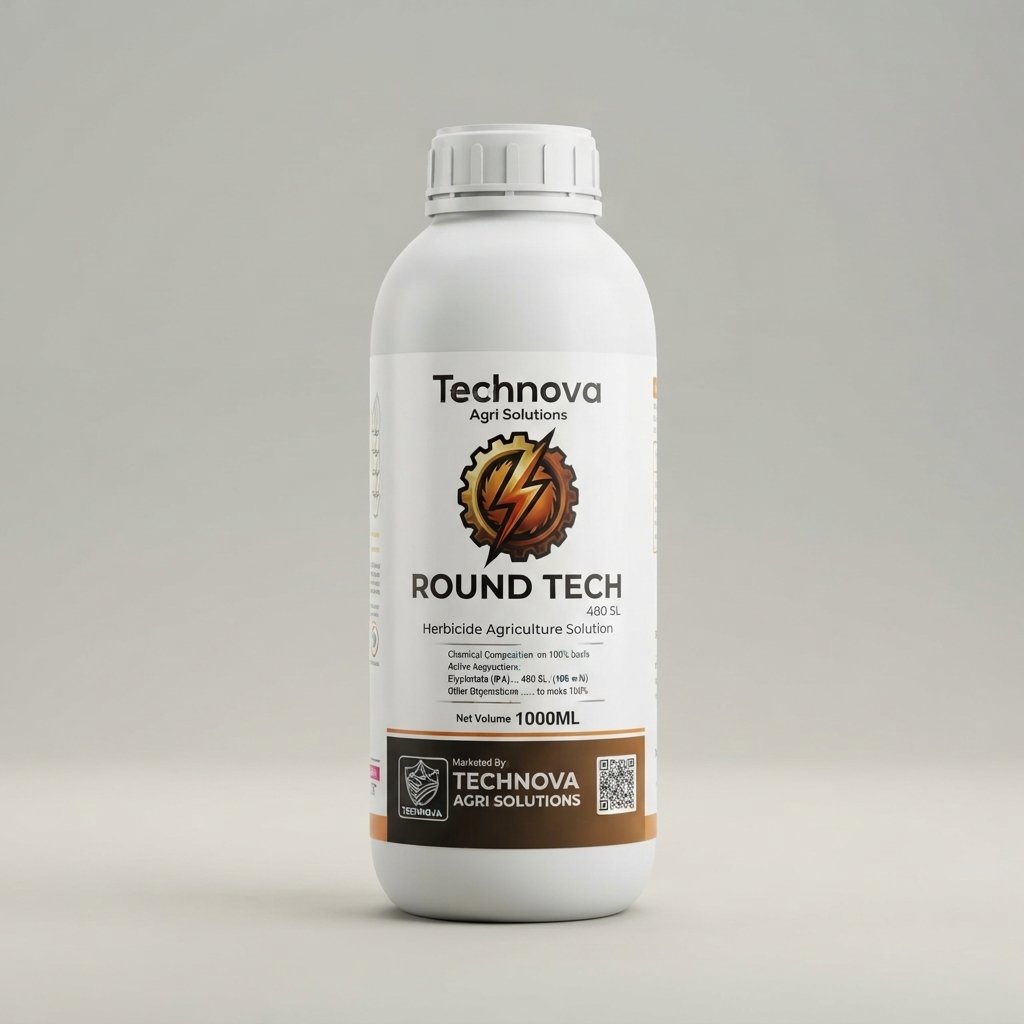
Round-Tech 48SL – Glyphosate Broad-Spectrum Non-Selective Herbicide by Technova Agri Solutions
Round-Tech 48SL by Technova Agri Solutions is a broad-spectrum, non-selective, systemic agricultural herbicide formulated with Glyphosate for post-emergence weed management.
Designed to target actively growing weeds, Round-Tech 48SL helps manage a wide range of annual grasses, broadleaf weeds and perennial weeds, including difficult species such as Khabbal (Bermuda Grass), Baru (Johnson Grass), Kahi (Wild Cane) and Deela (Nutgrass), with effectiveness varying by species and growth stage.
Its Soluble Liquid (SL) formulation is designed for dilution with water and application to actively growing weed foliage. Glyphosate is absorbed primarily through green leaves and transported to growing tissues, including underground plant parts, where it interferes with essential plant growth processes.
Round-Tech 48SL can be used for weed management in registered non-crop areas, before crop establishment and for approved directed applications, provided all product-label instructions are followed.
Key Features & Benefits
- Broad-Spectrum Weed Management: Targets susceptible annual grasses, broadleaf weeds and perennial weeds.
- Systemic Weed Control: Absorbed through foliage and transported to actively growing shoots and underground tissues.
- Non-Selective Herbicide: Controls susceptible green vegetation without distinguishing between weeds and desirable plants.
- Post-Emergence Activity: Designed for use on weeds that have already emerged and are actively growing.
- Effective Against Difficult Weeds: Can help manage established perennial grasses and weeds with underground storage structures.
- EPSPS Inhibition: Works by inhibiting an enzyme essential for the production of important plant amino acids.
- Convenient SL Formulation: Soluble liquid formulation for preparation of approved agricultural spray solutions.
- Versatile Weed Management: Suitable for registered applications such as pre-plant weed removal, non-crop weed management and protected directed spraying.
- Reduced Weed Competition: Helps reduce competition for water, soil nutrients, sunlight and growing space.
Technical Specifications
| Technical Parameter | Specification |
|---|---|
| Product Name | Round-Tech 48SL |
| Brand / Manufacturer | Technova Agri Solutions |
| Category | Pesticides |
| Subcategory | Weedicides / Herbicides |
| Active Ingredient | Glyphosate |
| Formulation | 48SL – Soluble Liquid |
| Active Ingredient Strength | Verify glyphosate salt, concentration and acid equivalent on product label |
| Chemical Family | Glycine Derivative |
| Herbicide Classification | Non-Selective |
| HRAC / WSSA Group | Group 9 |
| Mode of Action | EPSPS Enzyme Inhibitor |
| Primary Activity | Systemic, Foliar Absorption |
| Application Type | Post-Emergence |
| Application Method | Foliar Spray / Approved Directed Application |
| Residual Soil Activity | No reliable residual weed prevention |
How Round-Tech 48SL Works
Round-Tech 48SL contains Glyphosate, a systemic, non-selective herbicide classified under HRAC Group 9. It works by disrupting a critical biochemical pathway required for plant growth and development.
1. Absorption Through Green Foliage
Glyphosate is absorbed primarily through the leaves and other green tissues of actively growing weeds. Effective absorption depends on weed growth stage, leaf coverage, environmental conditions and formulation characteristics.
2. Systemic Movement Within Weeds
After entering the plant, Glyphosate is transported through the plant’s vascular system toward growing points, including shoots, roots, rhizomes and other underground structures.
3. EPSPS Enzyme Inhibition
Glyphosate inhibits the enzyme 5-Enolpyruvylshikimate-3-phosphate Synthase (EPSPS), an essential component of the shikimate pathway.
This process interferes with the formation of aromatic amino acids, including:
- Phenylalanine
- Tyrosine
- Tryptophan
4. Progressive Weed Growth Suppression
As normal plant metabolism is disrupted, susceptible weeds stop growing, develop chlorosis, gradually lose vigor and eventually show tissue necrosis.
5. Activity Against Underground Weed Structures
Systemic movement can help control underground plant parts of susceptible perennial weeds. However, complete control depends on sufficient absorption and movement within the plant. Established perennial weeds may require follow-up treatment or integrated weed management.
Target Weeds Controlled or Suppressed
Round-Tech 48SL is intended for broad-spectrum post-emergence weed management. Its effectiveness varies according to weed species, growth stage, herbicide resistance and application conditions.
1. Perennial Grasses & Sedges
| Common / Local Name | Scientific Name |
|---|---|
| Deela / Purple Nutgrass | Cyperus rotundus |
| Khabbal / Bermuda Grass | Cynodon dactylon |
| Kahi / Wild Cane | Saccharum spontaneum |
| Baru / Johnson Grass | Sorghum halepense |
Weed Management Focus: Glyphosate can help suppress or control susceptible perennial grasses through movement to underground tissues. Deep-rooted and tuber-producing weeds such as purple nutsedge may require multiple treatments for satisfactory long-term management.
2. Broadleaf Weeds
| Common / Local Name | Scientific Name |
|---|---|
| Bathu / Lamb’s Quarters | Chenopodium album |
| Lehli / Field Bindweed | Convolvulus arvensis |
| Itsit / Horse Purslane | Trianthema portulacastrum |
| Jangli Palak / Wild Spinach | Species identification required |
Weed Management Focus: Glyphosate can control susceptible broadleaf weeds when applied to actively growing foliage. Established field bindweed and other persistent perennial broadleaf weeds may require additional management.
3. Annual Grasses
| Common / Local Name | Scientific Name |
|---|---|
| Dumbi Sitti / Little Seed Canary Grass | Phalaris minor |
| Swank / Jungle Rice | Echinochloa colona |
Weed Management Focus: Young, actively growing annual grasses are generally easier to control than mature, drought-stressed or resistant weed populations.
Important: Local populations of some weed species may have developed resistance to Glyphosate. Confirm weed susceptibility and registered control claims before application.
Recommended Dosage & Water Calibration
The following rates are based on supplied preliminary product information. They must be verified against the official Round-Tech 48SL registration label, including the exact Glyphosate salt concentration and acid equivalent, before agricultural application.
| Target Situation | Proposed Dose / Acre | Proposed Water Volume / Acre |
|---|---|---|
| Annual Weeds & Fresh Green Growth | 1.0–1.25 Liters | 80–100 Liters |
| Hardy Perennial Weeds Deela, Khabbal, Baru | 1.5–2.0 Liters | 100–120 Liters |
| Field Borders & Non-Crop Areas Wats, Bunds and Other Approved Locations | 1.5–2.0 Liters | 100–120 Liters |
Important: These are unverified proposed rates and are not final application recommendations. Product rates vary between formulations and registration labels. Never apply directly to drainage water or irrigation channels unless specifically authorized.
20-Liter Knapsack Sprayer Calibration
The quantity of herbicide per 20-liter spray tank depends on the verified product rate per acre and the actual amount of water used per acre.
Use the following calculation only after confirming the product-label application rate:
Product per Tank (ml) = [Labeled Product Rate (ml/Acre) ÷ Water Volume (L/Acre)] × Tank Capacity (L)
Calibrate the sprayer before use. Do not assume that a fixed quantity per tank will always deliver the correct field rate.
Best Time to Apply Round-Tech 48SL
1. Ideal Weed Growth Stage
Apply to actively growing weeds at the growth stage specified on the registered label. Young annual weeds are generally more susceptible, while established perennial weeds may require treatment at a later stage that supports movement of Glyphosate into underground tissues.
Avoid treating weeds that are:
- Severely affected by drought or moisture stress.
- Recently cut, heavily grazed or mowed without adequate regrowth.
- Dormant or growing very slowly.
- Heavily covered with dust or mud.
- Under severe environmental stress.
2. Suitable Daily Spray Timing
Choose conditions that support active weed growth and good spray retention. Early morning after heavy dew has dried or late afternoon may be suitable, provided temperatures, wind conditions and other label requirements are satisfied.
3. Weather Conditions
- Avoid spraying during strong winds or conditions likely to cause drift.
- Do not spray when rain is expected before the label-specified rainfast period has elapsed.
- Avoid extreme temperatures that can reduce spray performance or increase drift.
- Follow the product label for specific weather and rainfall restrictions.
Step-by-Step Application Guidelines
1. Select Suitable Spray Equipment
Use properly calibrated agricultural spraying equipment and the nozzle type recommended on the product label. Drift-reducing flat-fan or suitable deflector nozzles may be appropriate for certain approved applications.
2. Maintain Correct Spray Pressure
Operate the sprayer at a pressure suitable for the selected nozzle and the manufacturer’s label instructions. Avoid excessive pressure that produces fine droplets and increases the risk of drift.
3. Prepare the Spray Solution
- Read the registered product label before mixing.
- Use clean water free from excessive sediment.
- Measure the approved product quantity accurately.
- Follow the recommended mixing sequence.
- Maintain uniform application throughout the treated area.
4. Ensure Uniform Weed Coverage
Apply uniformly to the target weed foliage according to label instructions. Avoid excessive overlapping, unnecessary runoff and spray drift.
5. Protect Desirable Crops & Plants
Round-Tech 48SL is a non-selective herbicide. Contact with green crop leaves, tender stems, exposed roots or other susceptible plant tissues can cause serious injury or plant death.
Use suitable drift protection and directed application methods only where permitted by the product label.
Orchard & Field-Border Weed Management
Directed Application in Orchards
Where the registered label permits orchard use, Glyphosate may be applied as a carefully directed treatment to weeds growing beneath or between established trees.
Important precautions:
- Use shielded or hooded spraying equipment where appropriate.
- Avoid contact with green bark, leaves, suckers and low branches.
- Prevent spray drift onto fruit trees and nearby crops.
- Do not spray exposed roots or other sensitive plant tissues.
- Follow crop-specific orchard restrictions and pre-harvest intervals.
Field Borders & Non-Crop Areas
Round-Tech 48SL may be relevant to management of unwanted vegetation on approved field borders, bunds and non-crop agricultural areas.
Avoid contamination of irrigation water, drainage channels, ponds and neighboring crops. All application locations must be authorized on the product label.
Expected Weed Control Symptoms
Glyphosate is a systemic herbicide, so visible symptoms usually develop gradually rather than immediately after spraying.
| Approximate Period | Possible Visible Symptoms |
|---|---|
| Days 1–3 | Weed growth may begin slowing, although visible symptoms may not yet be obvious. |
| Days 4–7 | Susceptible weeds may begin showing yellowing or chlorosis in growing tissues. |
| Days 7–14 | Progressive yellowing, wilting and browning may develop in affected foliage. |
| After 14 Days | Some perennial, woody or difficult-to-control weeds may continue declining over a longer period. |
Note: These periods are approximate and are not guaranteed product-specific results. Weed control may be slower or incomplete under unfavorable conditions, and surviving perennial weeds may regrow.
Best Practices for Effective Weed Management
1. Use Clean Water
Glyphosate performance can be reduced by certain dissolved minerals and suspended soil particles. Use clean water suitable for pesticide application and follow product-label guidance on water quality.
2. Consider Water Conditioning Only When Approved
Hard water containing calcium and magnesium may interfere with Glyphosate performance in some situations.
Ammonium sulfate or other compatible water conditioners may be used only when permitted by the registered product label and supported by appropriate water-quality recommendations. Do not add unapproved additives or assume a universal mixing rate.
3. Avoid Early Disturbance of Perennial Weeds
Glyphosate requires time to move within treated plants. Cutting, cultivating or disturbing perennial weeds too soon after application may reduce effectiveness.
Follow the official label for the required interval between spraying, mowing, cultivation and other field activities.
4. Maintain Proper Spray Tank Hygiene
Thoroughly clean the spray tank, hose, filters and nozzles after application according to label instructions. Herbicide residues left inside spraying equipment may damage sensitive crops during subsequent applications.
5. Monitor for Weed Regrowth
Inspect treated areas after the expected response period. Regrowth, new seed germination or resistant weed populations may require additional approved weed management measures.
Herbicide Resistance Management
Round-Tech 48SL contains Glyphosate, classified under HRAC / WSSA Group 9.
Repeated use of the same herbicide mode of action may contribute to the development of resistant weed populations.
- Avoid relying exclusively on Glyphosate for repeated weed control.
- Rotate or combine appropriate weed management practices.
- Use registered herbicides with different effective modes of action when required.
- Prevent surviving weeds from producing seed.
- Include mechanical, cultural and other integrated weed management methods.
- Monitor fields for unusually difficult-to-control weed populations.
Safety & Handling Precautions
- Read the Label: Always follow the complete registered product label.
- Wear Protective Equipment: Use suitable gloves, protective clothing, eye protection and other label-required PPE.
- Non-Selective Herbicide: Avoid contact with desirable crops, ornamentals, green tree tissues and other sensitive vegetation.
- Prevent Spray Drift: Do not spray during windy conditions or when droplets may move onto neighboring crops.
- Protect Water Sources: Avoid contamination of irrigation canals, streams, ponds and drinking water.
- Avoid Direct Exposure: Prevent skin and eye contact and inhalation of spray mist.
- Observe Label Restrictions: Follow all crop-specific application, grazing, harvest and re-entry instructions.
- Safe Storage: Store securely in the original, tightly sealed container in a cool, dry location.
- Keep Away from Children: Store away from children, livestock, food and animal feed.
- Dispose Responsibly: Follow label instructions and local regulations for handling empty containers and pesticide residues.
Why Choose Round-Tech 48SL?
Round-Tech 48SL by Technova Agri Solutions offers a Glyphosate-based, systemic herbicide option for broad-spectrum management of susceptible weeds in authorized agricultural and non-crop applications.
Its non-selective post-emergence activity can help manage annual grasses, broadleaf weeds and difficult perennial vegetation. When applied correctly, Glyphosate moves within actively growing weeds and can affect underground tissues as well as above-ground foliage.
Round-Tech 48SL is suitable for inclusion in responsible, integrated weed management programs that combine careful application, weed monitoring and appropriate resistance prevention strategies.
Product Information at a Glance
- Product Name: Round-Tech 48SL
- Brand: Technova Agri Solutions
- Active Ingredient: Glyphosate
- Formulation: Soluble Liquid (SL)
- Herbicide Type: Non-Selective
- Mode of Action: Systemic EPSPS Enzyme Inhibitor
- HRAC / WSSA Group: 9
- Application Stage: Post-Emergence
- Target Weeds: Susceptible Annual Grasses, Broadleaf Weeds and Perennial Weeds
- Application: Foliar Spray / Approved Directed Application
- Category: Pesticides – Herbicides / Weedicides
Disclaimer: All product specifications, active ingredient concentrations, application rates, weed claims, approved uses, rainfall intervals, tank-mixing instructions and safety requirements must be checked against the official Round-Tech 48SL product label registered in Pakistan. Glyphosate is non-selective and can severely injure desirable vegetation. A single application does not guarantee permanent weed eradication, and Glyphosate does not provide residual soil weed prevention. Always follow the manufacturer’s approved label instructions.